Disagree with an assessment. Watch the record update.
These are real RecrewOS screens, running offline on a fictional applicant, Jordan Okafor. Nothing in this section is a mock-up.
Open a screen full size. Re-checks use recorded answers; live AI reading is planned. Not open to customers or approved for real candidate data.
Other tools give you a score. Here is where the reasons help.
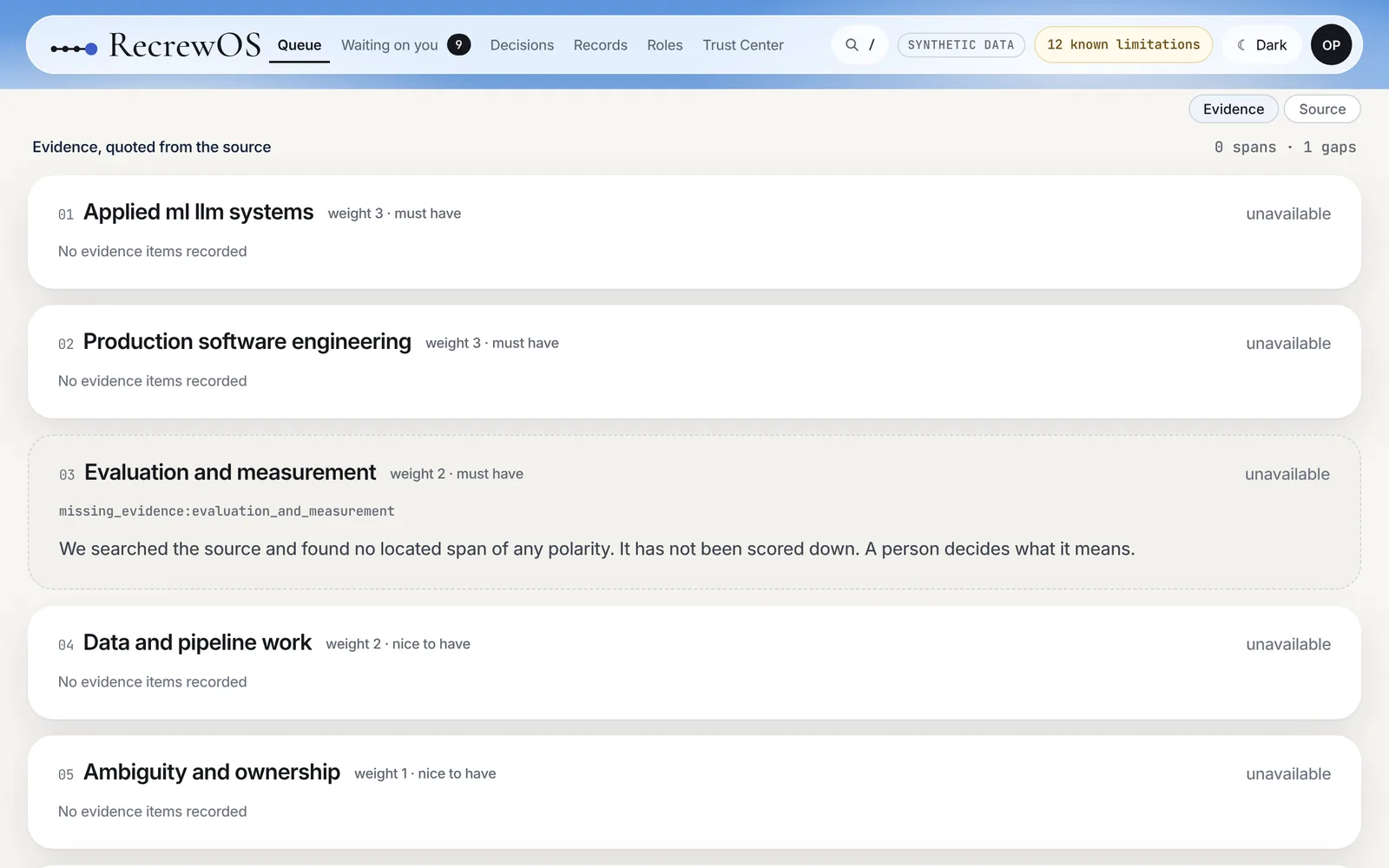
Start with the quoted lines for each skill. Clear cases are sorted; unclear ones carry a named reason for review.
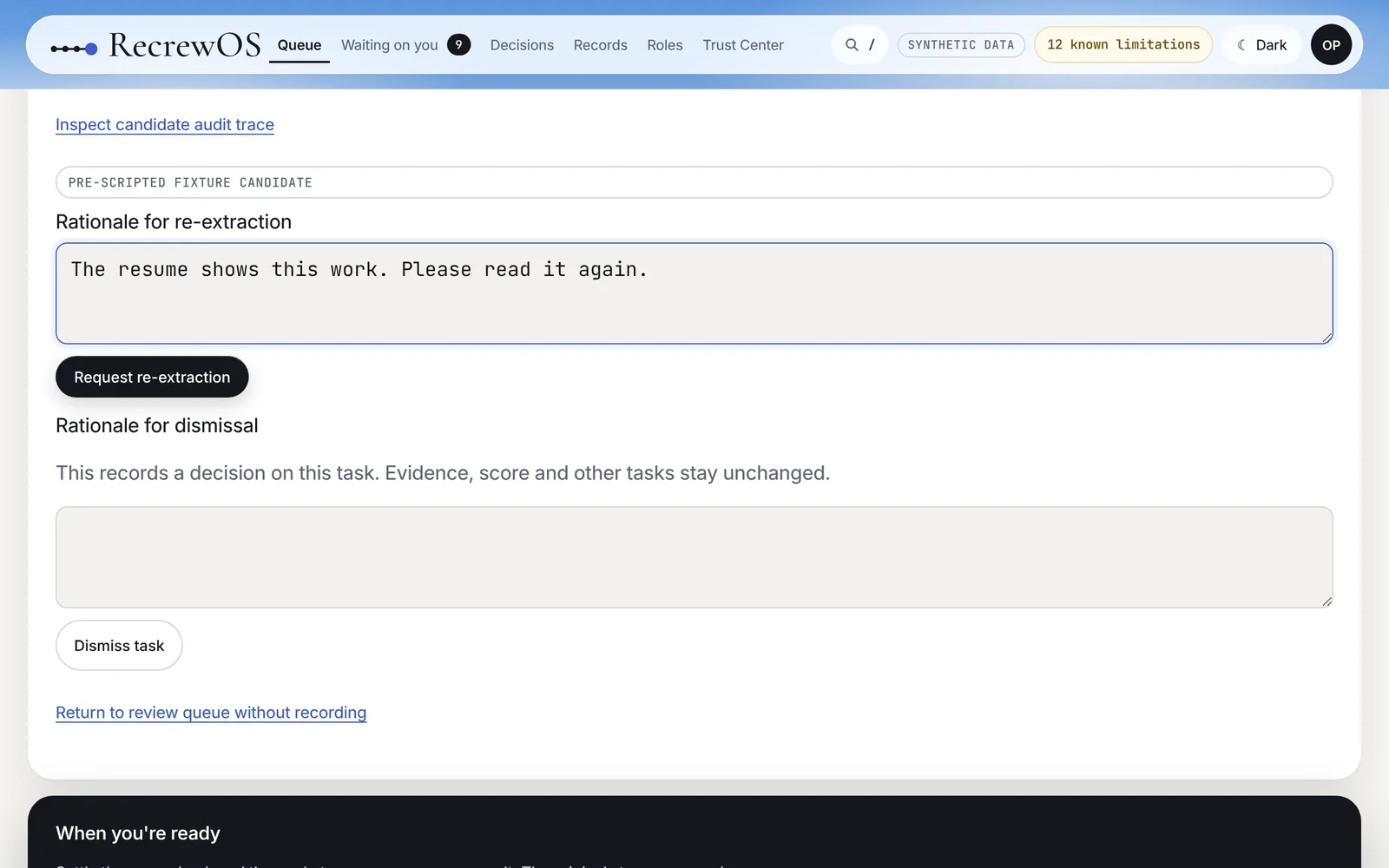
Ask for a re-check and record why. Compare the revised assessment with the original.
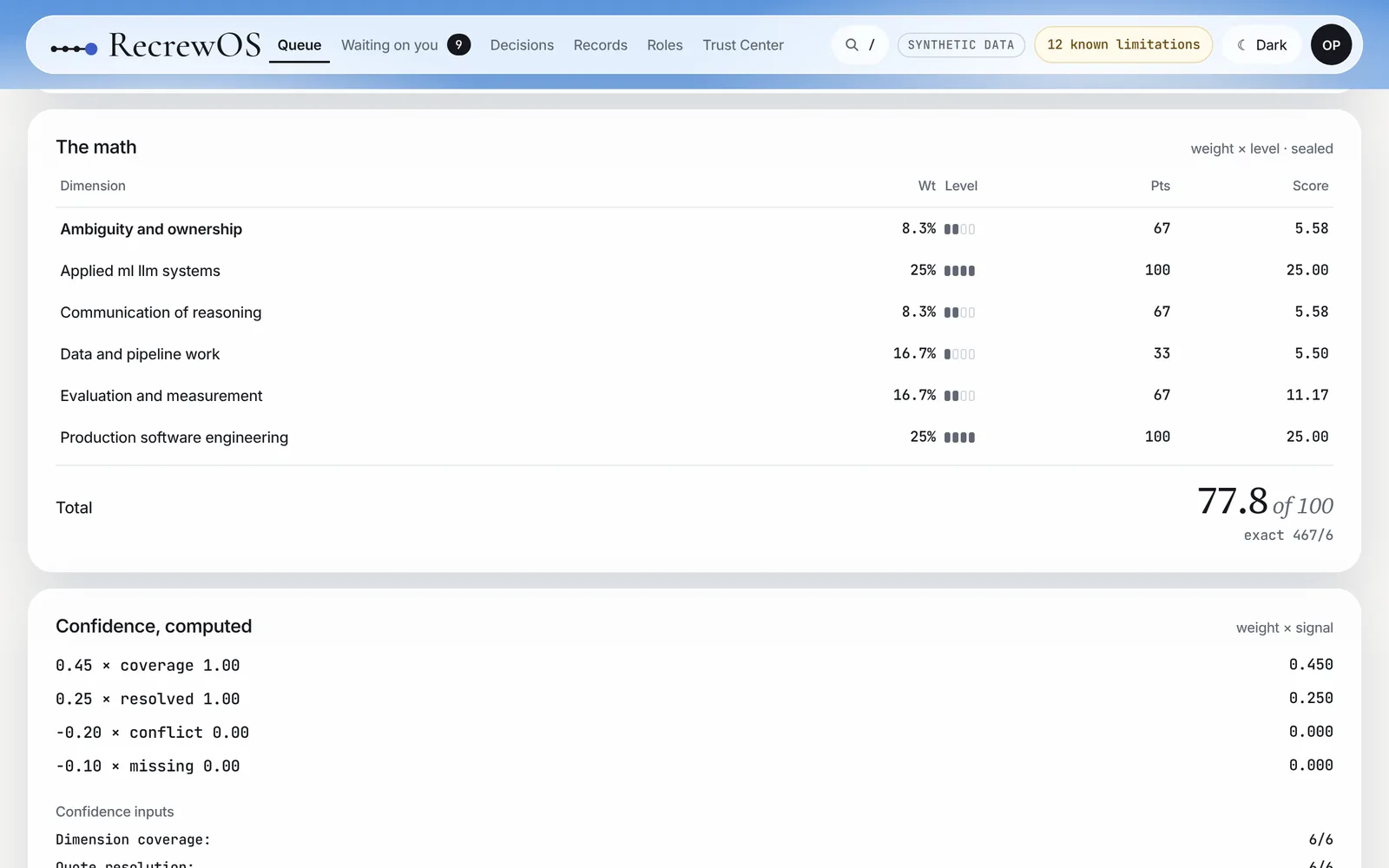
Give the hiring manager the evidence and the gaps to ask about, alongside the arithmetic.
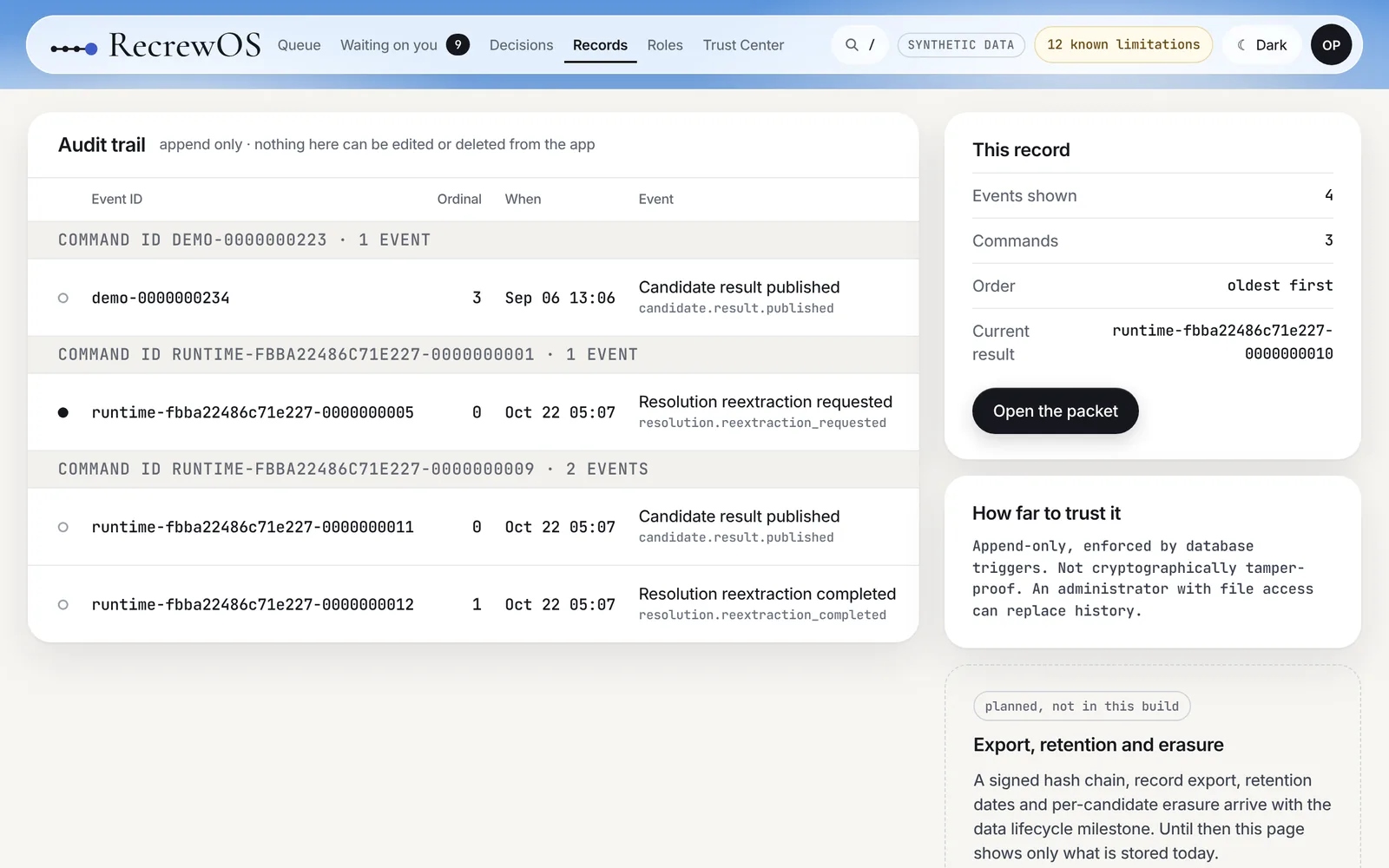
Open the criteria in force, the reviewer and their reason, instead of reconstructing the decision.
These workflows run in the offline demo. Sharing between accounts and portable exports are planned. See what works today.
Verified mechanics in our offline synthetic workflow. No real-resume accuracy claim.
Someone asks why they were rejected. Can you answer?
A match score, a hurried note and an unsaved rubric leave a decision hard to reconstruct.
- An 82% match scoreNo reasons attached. Nobody can say which words in the resume moved it.
- A recruiter's note"Not senior enough." Written in a hurry, in a different tool.
- A rubric that changed last monthNo version history, so the criteria used on the day are lost.
- A rejection emailGeneric, sent automatically, approved by nobody in particular.
- Three weeks of diggingWhen legal or the candidate asks, someone reconstructs it from memory.
- Quoted evidenceThe exact resume lines behind each criterion, with location, split into supporting, contradicting and missing.
- Arithmetic you can redoLevel times weight for each criterion, summed in the open.
- The rubric version in forceLocked when it was approved, with the reason each criterion is job related.
- A named reviewerWho decided, when, and what they saw.
- Inspectable historyReview the recorded evidence and decisions locally. Portable exports and cryptographic verification are planned.
From job description to reviewable decision.
From a locked rubric to a recorded decision, with uncertainty handed to a person at each step.
- 01RedactContact details are hidden before extraction.
- 02LocateExact resume lines are matched to criteria.
- 03RouteA missing requirement opens a human task.
- 04DecideA reviewer records the call and reason.
- 05ExplainA draft is filled from the saved record.
Follow fictional Jordan Okafor's journey in five steps. The tour panels below use separate illustrative records, not live product screens or Jordan's real-app results. Import, rubric drafting and candidate delivery are planned.
Approve the rubric before anyone is scored.
Job-description drafting is planned. The offline workflow uses versioned rubrics with criteria, weights, requirements and job-related reasons locked before scoring.
- A wording check is a first filter; a person still reviews the rubric
- Missing required evidence triggers human review, never silent rejection
- New rubric versions leave past decisions tied to theirs
| Criterion | Weight | Required | Why it is job related |
|---|---|---|---|
| Data pipelines | 3 | Yes | Owns daily ingestion into the warehouse |
| Production engineering | 3 | Yes | On call for services the team ships |
| Evaluation practice | 2 | Yes | Measures data quality before release |
| Ownership signals | 1 | No | Leads projects with unclear scope |
Import is planned. Failures stay visible.
Customer uploads are planned. Parsing runs on synthetic files only; internal normalization redacts contact details before extraction. No customer-resume processing is connected.
- Synthetic-file checks distinguish missing text, password protection and parse failures
- Possible duplicates route to human review in the offline workflow
- The offline scheduler bounds concurrency; customer throughput has not been measured
Read the evidence, not a percentage.
A packet groups the source lines and gaps by criterion. Missing required evidence opens a human-review task. The illustrative arithmetic is not a hiring decision.
- Click any quote to see it highlighted in the original resume
- Contradictions, such as a claimed title that dates do not support, are surfaced on their own
- Confidence comes from how much evidence was found, not from the model's opinion of itself
Explain a rejection in plain words.
In development: after a reviewer decides, an internal offline feature fills a deterministic draft from record fields. The AI does not write the reason. Customer delivery is planned.
- Every sentence links back to the field it came from
- Approval checks tie the draft to the decision
- The approved draft stays in the offline record
Thank you for applying for the Data Engineer role.
We reviewed your application against the criteria for this role (rubric version 4). Your resume showed strong experience in data pipelines. We did not find evidence of evaluation practice, which this role requires.
This decision was reviewed by M. Ortiz on October 14, 2026.
A history you can inspect.
The offline history records events for inspection. Tamper-evident hash chaining and signed checkpoints are planned, not implemented.
- Plannedverification that detects altered or reordered events
- Plannedcustomer-held signed checkpoints and a verification key
- Plannedretention and erasure controls, with a reviewable history
Every claim points to a line.
Character-level locations separate supporting, contradicting and missing evidence. Unlocatable quotes are dropped and reduce confidence.
A score you can redo by hand.
Level times rubric weight, added in the open. Identical inputs give identical scores; reviewers can challenge a specific term.
Working, available, approved. Three different things.
The application runs locally on fictional data. Customer use and real candidate records each require security, legal and data-use approval.
| Capability | Works in the demooffline, fictional data | Open to customers | Approved for real resumes |
|---|---|---|---|
| Quoted evidence and visible arithmetic | Yes | Not yet | Not yet |
| Human routing and corrections, with originals keptClosing a task does not change evidence or scores. | Yes | Not yet | Not yet |
| Locked, versioned criteria for each role | Yes | Not yet | Not yet |
| Contact details hidden before extraction | Yes | Not yet | Not yet |
| PDF, Word and CSV parsingUnreadable, locked, corrupt and duplicate files become named tasks. Customer throughput and setup time are unmeasured. | Sample files | Not yet | Not yet |
| Explanation drafts from record fieldsInternal approval checks retain the approved draft. | Yes | Not yet | Not yet |
| Risky wording checkIn development: blocks “recent graduate” and warns on “culture fit”; not a fairness guarantee. | Internal check | Not yet | Not yet |
| Live AI reading, upload screen and ATS connection | Planned | Not yet | Not yet |
| Sending explanations to candidates | Planned | Not yet | Not yet |
| Safeguards: planned, not available customer features | |||
| Customer isolation and hostingSeparate customer environments, databases and backups are proposed, not provisioned. | Planned | Not yet | Not yet |
| Encryption and managed keysPer-candidate encryption needs implementation and security review before customer use. | Planned | Not yet | Not yet |
| Retention and erasureKey-destroying erasure and backup handling are design goals. No established retention period or deletion guarantee. | Planned | Not yet | Not yet |
| Provider reviewNo live provider or customer DPA today. Terms, training restrictions and data-processing agreements need review before transfer. | Planned | Not yet | Not yet |
| Audit signingLocal history is inspectable, not cryptographic proof against alteration. Hash chaining and signed checkpoints are planned. | Planned | Not yet | Not yet |
| Access and exportCustomer accounts, multi-factor sign-in and PDF or JSON exports are not available yet. | Planned | Not yet | Not yet |
Planning for named obligations
- Candidate notice
- Planned: record the notice version received and when.
- Explanation
- Internal offline drafts are in development. Customer delivery is planned.
- Human review
- The offline workflow records human decisions; customer communication is not connected.
- Record keeping
- Retention policies and exports are planned. No three-year retention promise.
RecrewOS does not make you compliant and is not legal advice. Counsel determines which obligations apply and whether the completed workflow supports them. Responsibility stays with the employer.
One record, four kinds of reader.
Recruiters
Move through the queue using quoted proof, with gaps and mismatched dates surfaced before interviews.
HR and People leads
Read the reasoning behind a screening call without piecing together emails, notes and spreadsheets.
Hiring managers
See why a candidate reached you and which gaps deserve a question.
Legal and compliance
Walk through the evidence, reviewer and reason with counsel. Signed exports are planned.
We open with what it gets wrong.
Synthetic verification checks engineering behavior, not hiring accuracy or fairness. No real-resume accuracy study has been completed, and the customer workflow is still in development.
In synthetic-file tests, scans without a text layer are not read. They become named tasks for a person; no customer upload screen exists yet.
The proxy-term check is in development as an internal offline feature. It is a first filter, not a fairness guarantee; rubric review still needs a person.
Real-resume accuracy is unmeasured. Before making accuracy claims, we will evaluate against practitioner labels and report sample sizes, uncertainty and limitations.
RecrewOS records the screening it performs. It does not yet capture other tools' decisions.
Proof we still owe you
No customer pilot has run. These are future measurements, not results. We will report the bad numbers too.
- Review time
- Minutes per candidate against your current process.
- Corrections
- How often reviewers correct an assessment, and why.
- Agreement
- Whether two reviewers reach the same call.
- Time to answer why
- Time from a question to a complete record.
- Reviewer feedback
- What slowed people down or lost their trust.
“An unexplained score adds a step instead of removing one. The explanation is the product.”
Start with a pilot. Keep the record.
Proposed pricing, not a live offer. All packages and listed capabilities are planned; availability, limits and terms are not final. Customer isolation, encryption, exports and integrations are not available today.
Pilot
credited to year one
- Up to 3 open roles
- Up to 1,000 candidates
- Collaborative rubric setup
- Role-specific evaluation
- After a pilot
- $350 per reviewer per month, billed annually.Customer decision workflow in development; role and candidate limits to be agreed. Export, retention, erasure and signed daily checkpoints.
- Multiple teams
- Custom.For teams or regions: ATS connection, security review support and custom retention policies.
You've got questions. We've got answers.
Does the AI decide who gets rejected?
No. People decide. Recorded extraction output proposes quotes; code checks their locations and computes scores. Live model extraction and customer messaging are planned.
Will this make us compliant with AI hiring laws?
No. It is in development, not legal advice. Counsel determines applicable obligations and whether the completed workflow supports them. See the planned notice and retention controls above.
How is this different from the AI matching in our ATS?
Inspectable evidence, visible arithmetic and a human decision record are the focus. This is an offline demonstration; ATS integrations are planned.
Where is candidate data stored?
Locally, with fictional data only. Customer hosting, isolation, encryption and key-destroying erasure need implementation and review before customer data is accepted.
How accurate is it?
Real-resume accuracy is unmeasured. Synthetic replay checks pipeline behavior, not hiring quality. Practitioner-labeled evaluation is needed before accuracy claims.
